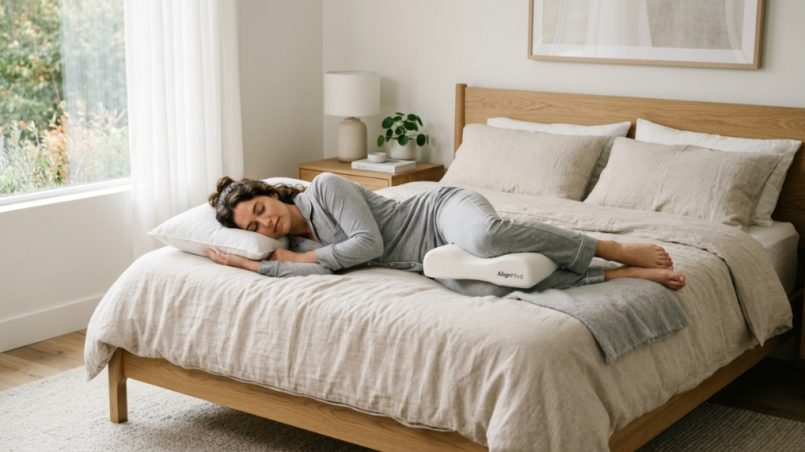
You wake up with a dull ache in your lower back, or perhaps a sharp pinch in your hip that wasn’t there yesterday. You toss all night, trying to find a comfortable position, but your legs feel like they are pulling your spine out of alignment. If this sounds familiar, you are likely a side sleeper missing one crucial piece of sleep gear: a dedicated leg spacer. The simple act of placing a pillow between your knees can be the difference between a restful night and a morning of stiffness. This guide will help you cut through the noise and select a knee pillow for side sleepers that actually works for your body type and sleep style, without wasting money on gimmicks.
While a standard bed pillow folded in half might seem like a quick fix, it rarely provides the targeted support needed to keep your hips square and your spine neutral. The right knee pillow is specifically contoured to fill the gap between your thighs and knees, reducing stress on your joints and improving spinal alignment. Whether you suffer from sciatica, hip bursitis, or simply want to improve your sleep posture, we’ve broken down the science, the materials, and the best practices to help you make an informed choice.
What Exactly Does a Knee Pillow Do for Your Body?
When you sleep on your side, the top leg naturally falls toward the mattress, causing your pelvis to twist and your spine to curve. A knee pillow blocks this drop, keeping the top leg parallel to the bed. This simple action stabilizes the pelvis, decompresses the lumbar spine, and reduces pressure on the sciatic nerve.
Many people assume knee pillows are only for pregnant women or post-surgery patients, but the reality is that any side sleeper can benefit. Without this support, your lower back muscles work overtime to hold your spine in a neutral position. Over time, this leads to chronic pain, poor sleep quality, and even misalignment in your neck and shoulders as your body compensates.
The Biomechanics of Side Sleeping
Your spine is most vulnerable while sleeping because your deep core muscles relax. The weight of your top leg (which can be up to 30 pounds) pulls on your pelvis, tilting it forward. This increases the gap between your ribs and hip, stretching the muscles on one side of your torso and compressing them on the other. A pillow bridges that gap, preventing the tilt.
Who Needs This Support Most?
Individuals with lumbar disc issues, hip replacements, or pregnancy-related pelvic pain find the most dramatic relief. However, even if you are pain-free, maintaining proper alignment during sleep is a proactive way to prevent future joint wear and tear, especially if you sleep on a firm mattress that offers less sinkage.
Why Does a Standard Pillow Fail to Provide Proper Support?
Standard pillows are too thick and too wide. When you squeeze a regular pillow between your knees, your top leg is forced upward, creating a lateral bend in your spine. This is often worse than using no pillow at all because it exaggerates the misalignment you are trying to fix.
Moreover, standard pillows lack the firmness and contour needed to stay in place throughout the night. They have a tendency to slide out from between your legs as you shift positions, waking you up to reposition. The goal is to have a pillow that feels like an extension of your leg, not a bulky obstacle.
The “Too Thick” Problem
If your pillow raises your top knee higher than your hip bone, you are shortening the distance between your ribs and pelvis on the top side, which can compress your lower back. A pillow that is too thick effectively “bananas” your spine out of alignment.
The “Too Soft” Problem
Feather or down pillows collapse under the weight of your leg, offering zero support. Your leg sinks through the pillow, bringing your knee back down to the mattress. You need a material that has enough density to resist your leg’s weight but enough give to be comfortable.
Which Materials Offer the Best Balance of Comfort and Support?
The best knee pillows use memory foam or latex cores. Memory foam contours to the shape of your leg, distributing pressure evenly, while high-resilience latex provides a springier “push back” that keeps your spine aligned without the sinking feeling.
You should avoid pillows filled with shredded foam that shifts easily or poly-fill that flattens quickly. The material must have a “shape memory” to hold its contour overnight. Additionally, the cover material matters—a bamboo or cooling gel cover will prevent heat buildup between your legs, which is a common complaint with foam products.
Memory Foam: The Contour King
Memory foam excels at pressure relief. It molds to your thigh and knee, creating a custom cradle. However, it can be dense and heavy, and some lower-cost versions retain heat. Look for “open-cell” foam that promotes airflow, which is essential for comfort on warm nights.
Gel-Infused vs. Natural Latex
Gel-infused memory foam actively pulls heat away from the skin, making it a great choice for hot sleepers. Natural latex, on the other hand, is more responsive and buoyant. It will not mold to your leg as tightly, but it offers a consistent “lift” that many orthopedic specialists prefer because it never goes flat.
How to Choose the Right Thickness for Your Build?
Take your measurements to match the pillow loft to your thigh width. A simple rule of thumb is that the height of the pillow (when compressed) should match the distance from your knee to your knee when your legs are stacked at right angles to your body. If you are a smaller frame (under 150 lbs), a 2.5-inch to 3-inch drop is usually ideal. If you are larger (over 180 lbs), you will likely need a 4-inch or 5-inch drop.
Most quality knee pillows come in standard sizes, but the market is shifting toward offering small/medium and large/XL versions. Paying attention to this size detail is the single most important factor in whether the pillow will work. A pillow that is too low will not open the joint space; one that is too high will cause hip pain,If you also need enhanced upper-body support alongside proper leg alignment, check out our guide on the Best King Size Pillow for Maximum Support to complete your ultimate sleep setup.
The Hip-Stack Test
Lie on your side and place the pillow between your knees. Have someone take a straight-on photo or use a mirror. If your top knee is perfectly in line with your hips, the loft is correct. If your knee is higher than your waist, it’s too thick. If your knee dips down, it’s too thin.
Adjusting for Mattress Firmness
On a plush mattress, your hips will sink deeper, meaning you might need a slightly thinner knee pillow because the mattress is already raising your leg alignment. On a firm mattress, you will need a thicker pillow to fill the wider gap created by the lack of sinkage.
When Is the Best Time to Switch to a Knee Pillow?
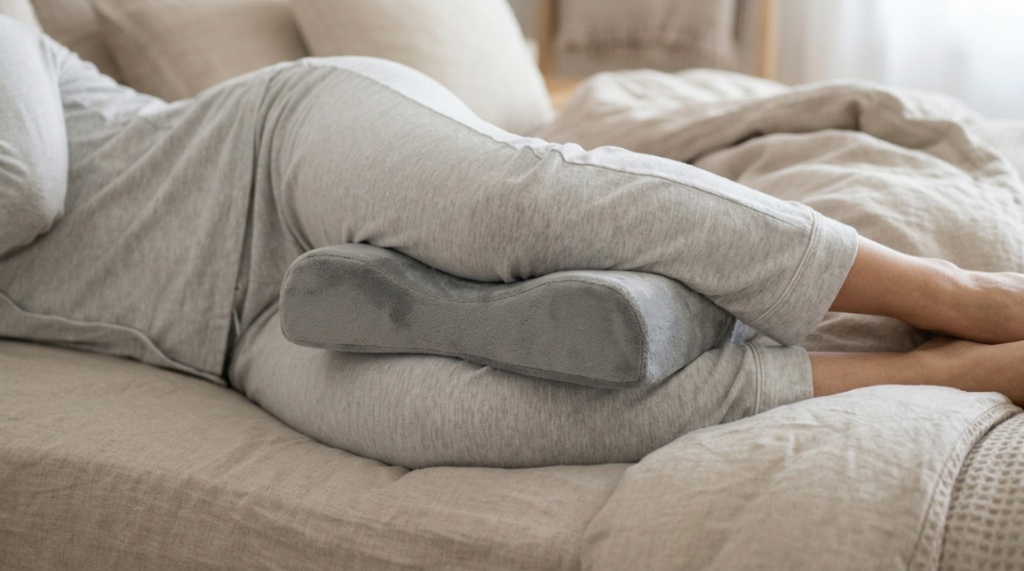
You should switch to a knee pillow the moment you notice you are waking up with lower back pain, even if it’s intermittent. Waiting until the pain becomes a daily occurrence is a mistake. It is also an excellent proactive choice if you are an athlete, as it helps with recovery by reducing tension in the hip flexors and psoas muscles.
Additionally, if you are a “mixed sleeper”—someone who starts on their side but transitions to their back—using a knee pillow can train you to stay in a better position. The pillow acts as a physical reminder, preventing you from rolling into awkward positions that compromise your spinal alignment during the night.
Signs You Need It Now
If you wake up with a sore hip, numbness in your legs, or a “stiff” back that loosens up after you start moving, you are already dealing with the consequences of misalignment during sleep. Don’t wait for the pain to spike; introduce the pillow as a preventive measure immediately.
Should You Use It Every Night?
Yes. Consistency is key. Using it only on nights when you feel sore will not correct the habit. Your body needs the consistent mechanical support to allow muscle memory to reset. After a few weeks, your sleep will feel strange without it because your body appreciates the alignment.
Can a Knee Pillow Help with Specific Pain Conditions?
Yes, a knee pillow is a medically recognized aid for several common conditions. It is not a cure, but it is a proven method to reduce mechanical stress. For sciatica, it reduces the stretch on the piriformis muscle. For hip bursitis, it prevents the compression that happens when your top leg pulls the IT band taut across the bursa.
Furthermore, for those with osteoarthritis in the hip or knee, a pillow provides a cushion that prevents bone-on-bone pressure during the night. Many physical therapists recommend this simple intervention before recommending invasive treatments, simply because the relief is so immediate.
Sciatica and Piriformis Relief
When your top leg drops, the piriformis muscle in your buttock stretches over the sciatic nerve. This aggravates nerve pain. By keeping the legs parallel, you keep the piriformis in a neutral position, easing the compression on the nerve root.
Upper Body Alignment Benefits
While it focuses on the lower body, the benefits travel upward. When your pelvis is square, your ribcage does not twist. This means your neck doesn’t have to rotate as far to keep your head level with your shoulders, which reduces morning neck pain and tension headaches.
How to Test a Knee Pillow Before You Keep It?
Whether you buy online or in a store, you need to test for three things: support, temperature, and retention. First, press down on the center of the pillow. It should compress to at least 50% but then push back slowly. If it compresses to the table and stays flat, it will not support you.
Second, hold it against your cheek. If it feels overly warm, it will feel worse between your hot legs. Third, check the cover’s friction. A slippery cotton cover will slide around. An ideal cover has a grippy texture or a non-slip backing that clings to your pajamas and skin.
The “Knee Squeeze” Test
Place the pillow between your knees and squeeze. You should feel a resistance that allows your thigh muscles to relax. If you have to actively grip the pillow to keep it there, the pillow is too small or the cover is too slippery.
The Roll-Away Test
Place the pillow on a flat surface and push it gently. If it glides easily, it will travel around your bed all night. Look for pillows with a flat bottom edge, which creates a suction-like base on the mattress, or those with a contoured curve that hugs your thigh.
What Are the Top Features to Look for in a Premium Pillow?
A premium knee pillow is more than just a block of foam. The design should be ergonomic, often shaped like a “log” with a dip in the middle. This contour cradles both the larger thigh muscles and the sensitive knee joint separately. Additionally, a strap is critical to keep the pillow attached to your leg while you turn.
Look for features like an adjustable strap that allows you to customize the fit. This is often the difference between a pillow that works and one that collects dust in the closet. The strap should be wide and made of a soft, stretchy synthetic material—a thin elastic band will create tight lines on your skin.
Ergonomic Cuts: The “Wing” Design
Some pillows have a “wing” that extends under your knee and sits on the mattress. This prevents the pillow from sliding backwards during the night and provides a stable base. It feels like a small wedge, which is highly effective for those who move a lot.
Strap Systems: Core or Full Leg?
A core strap that wraps around your thigh is standard, but the best models have a full-leg strap with two straps—one above the knee and one below. This keeps the pillow perfectly aligned even when you bend your knees slightly during the night, a common sleep position.
How to Care for Your Knee Pillow to Extend Its Lifespan?
Your skin oils and sweat can degrade foam quickly. If your pillow has a removable, washable cover, wash it weekly in cold water and air dry. This removes allergens and bacteria. The cover should have a hidden zipper to prevent snagging your sheets.
Do not machine wash memory foam cores. If the core needs cleaning, spot-clean it with a damp cloth and a mild detergent. Allow it to air dry completely before putting the cover back on. Direct sunlight and heat can break down the foam cells, so always dry it in a shaded, well-ventilated area.
The Flipping Routine
To prevent a permanent body impression, flip the knee pillow every few days. This redistributes the foam compression and keeps the supportive layer consistent. Most knee pillows are symmetrical, so flipping them is easy and doesn’t change the shape.
When to Replace Your Pillow?
If the foam no longer “bounces back” quickly after you press on it, or if you notice deep permanent creases, it’s time to replace it. The average lifespan is between 18 and 24 months. A saggy pillow is no better than a standard flat one and can actually work against your hip alignment.
Is a Cheaper Pillow Worth It or a Waste of Money?
A budget-friendly knee pillow can be as effective as a premium one if the foam density is right. However, many cheap options use a low-density foam that flattens out within a month. Your priority should be the thickness and density, not the price tag.
You can absolutely find effective options under $25. The key is to check the foam density (in pounds per cubic foot) and the return policy. If a brand is transparent about using solid foam without fillers or crumbling, it is likely a safe bet. Avoid “shredded” foam cores at all costs—they offer zero structural integrity and shift around as you sleep, creating pressure points.
If you are looking for a roundup of affordable options that have been tested for quality, you can check out this curated list of the [best affordable knee pillows for side sleepers](https://pillowshowcase.com/pillow-for-different-needs/best-affordable-knee-pillows-for-side-sleepers/). That resource offers a comparison of foam types and price points to save you from trial and error.
Reading Between the Review Lines
Ignore reviews that rave about comfort but never mention alignment. Focus on reviewers who specifically mention waking up without hip pain or who note that the pillow stayed in place. These are the real-world validation points you need to trust the product.
| Feature | Good Budget Picks (Under $30) | Premium Picks (Over $50) |
|---|---|---|
| Foam Type | Standard Viscoelastic | Gel-Infused or Latex Hybrid |
| Cover | Cotton Blend | Bamboo Lyocell with Cooling Gel |
| Strap | Basic Elastic (narrow) | Wide, Anti-Slip Silicone Grip |
| Height Options | One Size Fits Most | Multiple (S, M, L, XL) |
Can I Use a Knee Pillow if I Switch Sides During the Night?
Absolutely, and this is where a strap becomes non-negotiable. If you have a strapless pillow, you will likely wake up when you roll over because the pillow will be misplaced. With a strapped pillow, it rotates with your leg as you move, keeping the support continuous.
Some side sleepers worry that a strap restricts movement or feels too restrictive. However, modern straps are made of breathable, stretchable fabrics that feel snug but not tight. You can adjust the Velcro or buckle to a fit that is just tight enough to stay in place without digging into your skin. This allows you to roll from one side to the other without consciously thinking about the pillow.
Rolling to Your Back
If you roll onto your back, simply remove the pillow and place it under your knees or push it aside. Trying to keep your legs together while on your back puts pressure on your sacroiliac joint. A knee pillow is designed only for resting on your side.
Training Your Sleep System
In the beginning, you might find yourself “losing” the pillow when you toss and turn. Your body is learning. After a week, your sleep positions will adapt, and the pillow will become a natural extension of your leg, allowing for seamless side switching without interruption.
Frequently Asked Questions
Can a knee pillow help with lower back pain?
Yes, it is one of the most effective mechanical aids. By keeping your pelvis neutral and preventing your top leg from pulling your lumbar spine into torsion, it reduces strain on the muscles and discs. This results in significant relief for many people, especially those with disc bulges or facet joint pain.
How thick should a knee pillow be?
Aim for a thickness that aligns your top hip with your bottom hip. For most people, this is between 3 and 5 inches. The pillow should compress about 20% when you place your leg on it. If your knee lifts higher than your hip, the pillow is too thick.
Is it better to use a knee pillow or a body pillow?
Both work, but a specific knee pillow is often more effective because it is less bulky and less likely to cause shoulder or neck issues. A full body pillow can pull your top arm into an awkward position. A knee pillow targets the pelvis directly without affecting the upper body.
Why does my knee hurt at night when sleeping on my side?
This is often due to the pressure of the bony part of your knee pressing against the other knee, or because the joint is twisted by the misaligned pelvis. A knee pillow pads the knees and prevents the twisting motion, reducing the strain on the ligaments and cartilage.
Can a knee pillow help with restless legs syndrome?
While not a medical treatment, providing support and relieving pressure can reduce nerve stimulation. Patients report fewer involuntary twitches because the muscles feel less cramped. It is worth trying as a supportive measure alongside any medical treatments prescribed by your doctor.
How do I clean a memory foam knee pillow?
Always check the label, but most covers are machine washable in cold water. The foam core should never go in the washing machine. Spot clean the core with mild soap and water, then let it air dry completely. Avoid wringing it out, as that can tear the foam structure.
Conclusion
Choosing the best knee pillow for side sleepers is not about buying the most expensive model, but about understanding your body’s specific geometry. The primary goal is to maintain a neutral spine alignment from your neck down to your pelvis. A knee pillow is a simple, low-tech tool that delivers surprisingly profound results for your sleep hygiene.
We recommend starting with a contoured foam pillow that offers a height appropriate for your frame, and prioritize one with a secure, comfortable strap system. Remember to test it in the context of your current mattress firmness. The right pillow should feel like you are floating, with no pressure in your hips or lower back.
Don’t let another night of tossing and turning pass you by. Invest a small amount of time and money in this ergonomic upgrade. You’ll wake up with more energy, less pain, and a clearer mind. Your spine works hard for you—give it the support it needs.