You have finally decided to shave strokes off your handicap and buy a rangefinder. You walk onto the first tee, laser the flag, and pull a club. But the shot lands 15 yards long. What went wrong? The mistake wasn’t your swing; it was the device in your hand.
Buying a rangefinder is a simple process, but buying the right one is a minefield of marketing gimmicks and technical jargon. Most golfers waste money on features they do not need or miss essential specs that change their game. This golf rangefinder buying guide will help you dodge the common traps so you can buy with confidence and hit your target every time.
What Is the Single Biggest Mistake Golfers Make When Buying a Rangefinder?
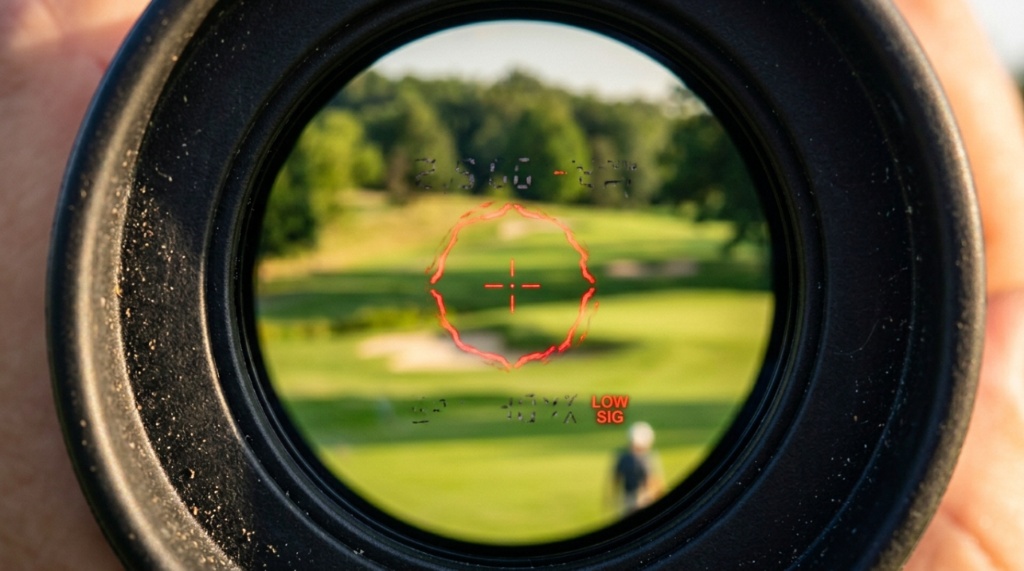
Ignoring the vibration or pulse confirmation feature. If your rangefinder does not clearly tell you when you have locked onto the flag, you are guessing. A flagstick is a thin target. Without a reliable lock-on indicator, you will accidentally range a tree behind the green or a bunker in front, leading to poor club selection.
Most budget devices lack a multi-coating on the lens or a fast processing chip. This results in “flag jockeying,” where you struggle to get a consistent reading. A good rangefinder should give you a number instantly and vibrate in your hand to confirm the lock. This feature is non-negotiable for accuracy.
Why Is Slope Technology Both a Blessing and a Trap?
Slope technology adjusts distances for elevation changes. It is incredibly useful for hilly courses. However, if you buy a rangefinder with slope and do not check the local tournament rules, you will break the rules of golf. Many competitions ban slope-adjusted devices because they provide an unfair advantage.
Here is the trap: Golfers buy a slope rangefinder thinking it will always help. In reality, if you play 90% of your golf on flat courses, slope is a wasted feature that adds cost. Furthermore, if you intend to compete, you must buy a model that allows you to toggle the slope function on and off. A device that permanently has slope enabled is useless for tournament play. Always check if the device is “tournament legal” (slope-disabled) before you buy.
The Cost of Slope
- Pros: Accurate uphill/downhill adjustments, better club selection on hilly terrain.
- Cons: Higher price, illegal in many tournaments, unnecessary for flat courses.
Which Rangefinder Feature Do You Actually Need?
You need three core features: accurate laser ranging, flag-lock vibration, and decent magnification (6x to 7x is standard). Everything else is a bonus. Most golfers get distracted by features like “Jolt Technology,” “E.S.P.” (Extreme Speed Precision), or “Scan Mode.” While these are helpful, they are not essential for the average player.
The most important feature is accuracy. A unit that provides yardages within +/- 1 yard is superior to a unit with 20 fancy modes that is off by 3 yards. Prioritize build quality and lens clarity over gadgetry. A rangefinder with a rubber armor coating and water resistance will outlast a cheap plastic unit with more features.
How Do You Choose Between a Rangefinder and a GPS Watch?
Choose a laser rangefinder if you want precise distance to the flag. Choose a GPS watch if you want front, middle, and back distances quickly without pointing a device. The biggest mistake is buying a GPS for target-specific shots. A GPS cannot tell you the exact distance to a flag hidden behind a tree or a specific bunker lip.
Rangefinders are better for players who want to attack pins and understand course geometry. GPS watches are better for players who want pace of play and general yardages. If you can afford it, owning both is ideal, but most amateurs benefit more from the precision of a laser.
Can You Trust Cheap Rangefinders Under $100?
You cannot trust them for tournament play or consistent performance. While technology has improved, rangefinders under $100 often suffer from poor lens coatings, slow acquisition times, and unreliable flag-lock technology. They may work fine on a sunny day against a close pin, but they struggle in low light, rain, or against distant targets.
However, for a beginner or a casual golfer, a cheap rangefinder is better than nothing. The key is to manage expectations. Do not expect it to last five years. If you buy a budget unit, test it against a friend’s quality rangefinder to verify its accuracy. If the cheap unit is consistently off by more than 3 yards, return it.
When Should You Pay Extra for Premium Branding?
Pay extra for premium brands (like Bushnell, Leupold, or Precision Pro) only when you need reliability in harsh conditions or tournament legality. These brands invest in better optics, waterproofing, and customer service. The mistake is buying a premium brand for the logo rather than the performance.
If you play once a month in sunny weather, a mid-tier brand is perfectly fine. If you play in the Pacific Northwest rain, early morning fog, or competitive events, a premium brand is worth the investment because they offer better light transmission and faster processing. Ask yourself: Does my golf game depend on this device being right every single time? If yes, go premium.
Is Magnification or Lens Quality More Important?
Lens quality is more important than magnification. A 7x lens with poor glass gives a blurry, hazy image that makes locking onto the flag difficult. A 6x lens with fully multi-coated optics provides a bright, sharp image that makes ranging effortless. Do not sacrifice lens clarity for an extra 1x of magnification.
Look for terms like “fully multi-coated” or “ED glass” (Extra-low Dispersion). These reduce glare and chromatic aberration (color fringing). A good rule of thumb: if you look through the rangefinder and the image looks soft or yellowish, put it back on the shelf.
How Do You Verify Accuracy Before Buying?
You cannot test a rangefinder in a store effectively because the distances are too short. Instead, check the manufacturer’s specifications for “accuracy tolerance.” Look for a specification of +/- 1 yard or better. Avoid any product that does not list its accuracy tolerance.
After purchasing, test the device against a known distance. On a driving range, measure a yardage marker (e.g., a 150-yard pole). If your rangefinder reads 148 or 152, it is within acceptable tolerance. If it reads 145 or 155, return it. Also, test the lock-on feature by ranging a distant tree. The unit should lock onto the tree, not the branches in front.
What Is the Deal with Hunting vs. Golf Rangefinders?
Hunting rangefinders are built for durability and long-range target acquisition. Golf rangefinders are built for speed and flag-lock precision. The biggest mistake is buying a hunting rangefinder for golf. Hunting units often use different wavelength lasers and lack “PinSeeker” or “Flag-Lock” technology.
However, some hybrid units exist that work for both. If you are a hunter who also golfs, look for a unit that explicitly states “Dual Purpose” or “Golf/Hunting” mode. If you are strictly a golfer, buy a dedicated golf rangefinder. For an excellent comparison of models that work for both sports, check out this comprehensive golf rangefinder buying guide that breaks down the best dual-purpose units on the market.
Does Battery Life Really Matter That Much?
Yes, but not in the way you think. Most rangefinders use a standard CR2 battery which lasts for hundreds of rounds. The mistake is not buying a model with a low-battery indicator. You do not want to be on the 16th hole with a dead battery.
Another common error is forgetting that cold weather drains batteries faster. If you play in winter, carry a spare battery in your bag. Some newer models have rechargeable batteries (USB-C), which are convenient but require remembering to charge them. Standard batteries are often more reliable for the forgetful golfer.
Once you find the perfect rangefinder for the course, learn how to practice your game at home. Check out our step-by-step guide to Build a Portable Golf Simulator Setup with a Laptop.
How Important Is the Carrying Case and Form Factor?
More important than you think. A bulky rangefinder with a flimsy case is a recipe for disaster. You will either leave it in the car because it is annoying to carry, or you will drop it because the case does not hold it securely. Look for a unit that fits comfortably in your hand and has a magnetic strap or a clip that attaches to your bag easily.
A magnetic cart mount is a game-changer for riders. If you ride a cart, buying a rangefinder without a magnetic mount is a missed opportunity. These magnets allow you to stick the unit to the roof of the cart for instant access. Do not underestimate convenience; the best rangefinder is the one you actually use on every shot.
Frequently Asked Questions
Do I need a rangefinder if I already use a GPS app on my phone?
Yes, if you want precise distance to the flag. GPS apps are often accurate to +/- 5 yards due to satellite inconsistency and lack of manual targeting. A laser rangefinder is accurate to +/- 1 yard and lets you measure specific hazards, making it superior for course management.
What is the difference between a premium and a budget rangefinder?
The main differences are lens quality, processing speed, and durability. Premium units use multi-coated lenses for brighter images, faster processors for immediate lock-on, and robust weatherproofing. Budget units often have slower lock-on, lower light performance, and shorter lifespans.
Can I use a hunting rangefinder for golf?
You can, but it is not ideal. Hunting rangefinders lack “Flag-Lock” technology designed to isolate the flag from the background. They also often have higher magnification which can be shaky. Dedicated golf rangefinders are optimized for the specific distances and targets found on a course.
What does “Slope” mean on a rangefinder?
Slope calculates the distance adjustment based on the angle of elevation or decline. It tells you the “plays like” distance. For example, 150 yards uphill plays like 160 yards. This feature must be disabled for tournament play, so look for a model with an on/off switch.
Is a rangefinder worth it for a high-handicapper?
Absolutely. Knowing the exact distance eliminates one variable from your game. High-handicappers often misjudge distances, leading to poor club choices. A rangefinder helps you focus on your swing, not on guessing the yardage. It is a tool for learning distances.
How do I care for my rangefinder?
Store it in its case when not in use. Clean the lenses with a microfiber cloth only. Avoid dropping it, as this can misalign the internal laser. Remove the battery if you are storing it for the winter to prevent corrosion. Treat it like a precision instrument.
What magnification is best for golf?
6x to 7x magnification is ideal. 5x can feel too weak for long par-5s, while 8x can be too shaky to hold steady without a tripod. 6x or 7x provides the best balance of stability and image size for the standard golf course distances of 50 to 250 yards.
Conclusion
Buying a golf rangefinder does not have to be complicated. The biggest mistakes stem from chasing low prices, ignoring essential features like vibration lock-on, or buying technology you cannot legally use. Focus on accuracy, a clear lens, and tournament legality if you compete. A solid mid-range unit from a reputable brand will serve you better than a high-end gadget with features you never use. Take your time, test the device when you get it, and trust the numbers it gives you. With the right tool in your hand, you will start hitting greens with more confidence. Now, go buy that rangefinder and start shooting lower scores.